Astrophotography Basics: Capturing the Cosmos
Transitioning from visual observation to astrophotography is a rewarding challenge. Capturing faint galaxies and colorful nebulae requires patience, specialized techniques, and an understanding of how light interacts with digital sensors over time.
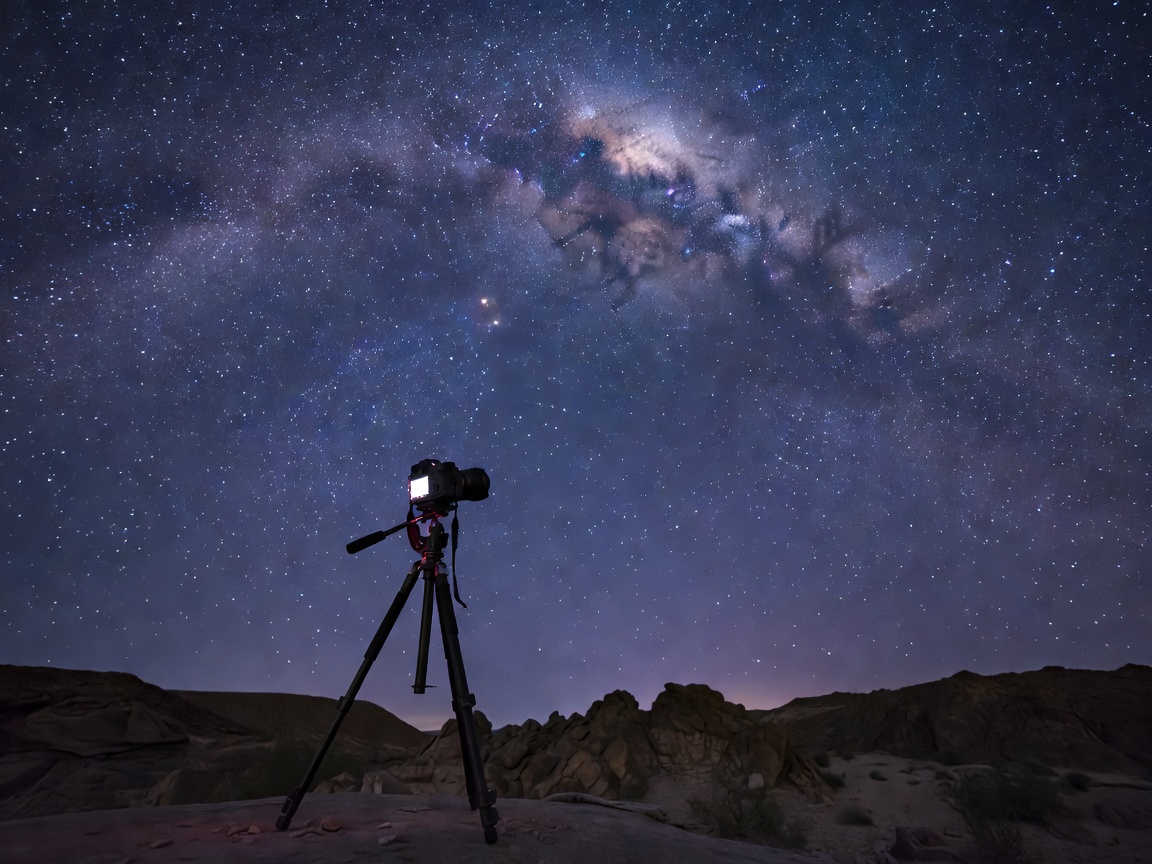
The Power of Long Exposures
The human eye is an incredible biological instrument, but it operates in real-time. It cannot store light over long periods. Camera sensors, however, can absorb photons for minutes or even hours, gradually building an image of objects that are completely invisible to the naked eye. This principle of long exposure is the foundation of all astrophotography.
To capture deep-sky objects, you must open your camera's shutter and let light accumulate. The longer the shutter remains open, the more detail and color the sensor records. However, a major hurdle presents itself immediately: the Earth is rotating.
Overcoming Earth's Rotation: Tracking
If you place a camera on a fixed tripod and open the shutter for more than a few seconds, the stars will blur into streaks, known as star trails. While star trails can be beautiful artistic compositions, they obscure the fine details of nebulae and galaxies.
To take long exposures of deep-sky objects, the camera must precisely match the apparent motion of the stars. This is achieved using an equatorial tracking mount. Once polar-aligned (aligned perfectly with the celestial pole), the mount's internal motors slowly rotate the camera in the exact opposite direction of the Earth's spin. This allows for exposures lasting several minutes without the stars trailing, capturing incredibly faint light.
Getting Started: Untracked Wide-Field Photography
You do not need heavy, expensive gear to begin. You can capture stunning images of the Milky Way, constellations, and meteor showers using basic equipment you may already own.
- Equipment: A DSLR or modern mirrorless camera, a sturdy tripod, and a fast, wide-angle lens (typically 14mm to 24mm with an aperture of f/2.8 or wider).
- The 500 Rule: To avoid star trails on a stationary tripod, use the 500 Rule. Divide 500 by your lens's focal length to find your maximum exposure time in seconds. For a 20mm lens, 500 / 20 = 25 seconds.
- Settings: Set your camera to manual mode. Open the aperture as wide as possible (lowest f-number). Set ISO between 1600 and 3200 depending on ambient light pollution. Focus manually on a bright star using your camera's live view magnification.
The Magic of Image Stacking
In deep-sky astrophotography, a single long exposure is rarely enough. Digital sensors generate electrical noise—random grain that degrades the image quality, especially in dark areas. To combat this, astrophotographers use a technique called image stacking.
Instead of taking one 60-minute exposure, you might take sixty 1-minute exposures. Specialized software (such as DeepSkyStacker or Siril) analyzes all these individual images, aligns the stars perfectly, and averages them together. Because the signal (the light from the galaxy) is consistent across all frames, while the noise is random, stacking dramatically increases the signal-to-noise ratio. The resulting master image is smooth, incredibly detailed, and ready for post-processing adjustments to contrast and color.
Dedicated Astronomy Cameras
While standard DSLRs are excellent starting points, serious astrophotographers eventually transition to dedicated CMOS astronomy cameras. These devices differ from consumer cameras in several key ways.
Firstly, many dedicated astro-cameras feature active thermoelectric cooling (TEC) systems. By cooling the sensor to well below ambient temperatures, they drastically reduce thermal noise during long exposures. Secondly, many are monochrome (black and white). While capturing in color seems intuitive, monochrome sensors are more sensitive to light and provide higher resolution. Color images are created by taking sequences of exposures through separate red, green, and blue optical filters, then combining them in software.
Regardless of the equipment you choose, astrophotography is a discipline of perseverance. The learning curve is steep, and troubleshooting equipment in the dark is part of the experience, but the first time you resolve the spiral arms of a distant galaxy on your screen makes the entire journey worthwhile.